
Preâmbulo nº 3
Português · English
Art, memory, and human rights
Created especially for the ECA 60 Anos exhibition, this cultural project brings together documentary research, visual art, and writing to introduce constitutional law, human rights, and Brazilian history to people without a legal background.
In the Preâmbulos series, figures and events from Brazilian history are set against the promises of the Constitution. In this work, Vladimir Herzog’s portrait and fragments of a judicial ruling invite reflection on state violence, memory, and the delay in official acknowledgment.
The work was presented at USP’s Innovation Center from September 21 to October 2, 2026, a few weeks before the October 25 anniversary of the murder of Herzog, who taught at ECA in 1975.
The project extends into the essay below and into articles, bulletins with commentary, and other content in Communication and Research, with sources for further reading.
Preâmbulo nº 3 at the ECA 60 Anos exhibition, USP Innovation Center, São Paulo, 2026. Photo: Otavia Cabral.
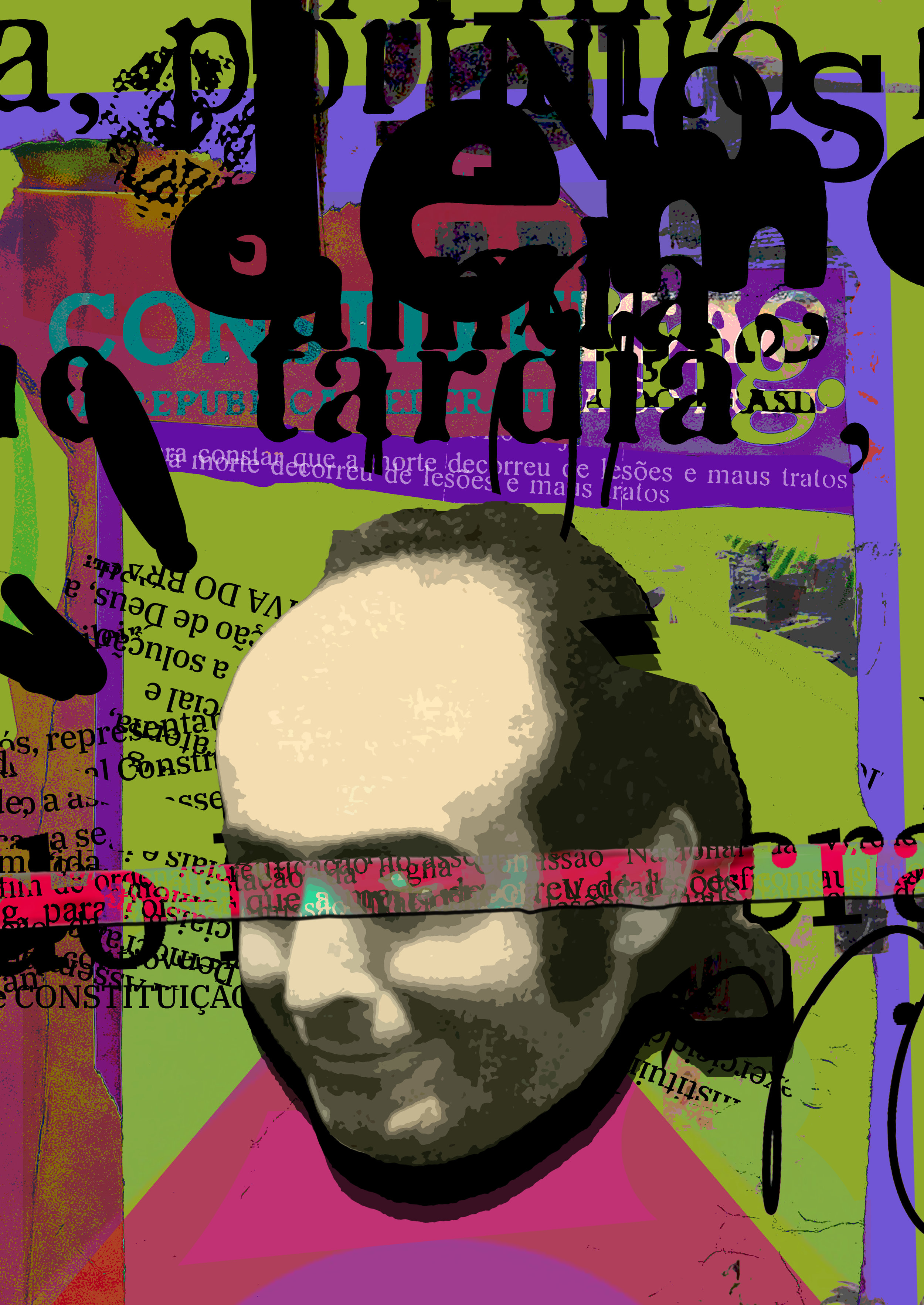
MENDES, Lucas. Preâmbulo nº 3. 2026. Digital photomontage, pigment print on canvas, 42 × 59.4 cm. Series: Preâmbulos.
HOWEVER
BELATED
Almost four decades separated a death from the correction of its certificate. Vladimir Herzog was murdered at DOI-CODI in 1975, and the fabricated account of suicide survived Brazil’s return to democracy and remained on his death record. Only in 2013, after a long struggle by his family, did the amended certificate state that his death had resulted from “injuries and mistreatment.” The Constitution that had promised freedom and justice was, by then, more than two decades old.
That delay was my starting point for Preâmbulo nº 3, made for the 60th-anniversary exhibition of USP’s School of Communications and Arts, where Herzog taught for a few months before he was murdered. The work belongs to the Preâmbulos series—a kind of spin-off from Neoantropofagia—in which I bring figures from Brazilian history into contact with constitutional promises. Here, the portrait, the text of the Constitution, and fragments of the judicial ruling meet to expose a mismatch: the brutality of the events and the composure with which official language manages to accommodate them.
I show Herzog alive, his features simplified, almost cartoonlike, surrounded by acid greens, violets, and pinks. The graphic exuberance invites levity into a subject that seems to forbid it. Through this mismatch, I try to dig into the discomfort: the color beckons, the face draws us closer, the words begin to weigh. The familiarity of the portrait is gradually disturbed by the words around it.
Passages from the ruling cross the journalist’s eyes. The strip informs and obstructs: it allows us to read the acknowledgment of violence while interrupting our encounter with the gaze of the person who suffered it. The document begins to act within the image, cutting through the face, intersecting the expression, competing for our attention. The very language of redress acquires an unsettling presence.
At the top, I enlarge the phrase “ainda que tardia”—“however belated”—taken from the ruling. What might pass as an understated qualification gains weight and takes up space. I want to give the delay a sense of scale: between the violence, public knowledge of it, and the correction of the record, collective life went on, openly coexisting with the sham. Routine, despite the lie.
Correcting the certificate does not restore that time, undo the loss, or, by itself, punish those responsible. The fracture remains recognizable in the names that came afterward—Amarildo, Ágatha, so many others—and in the ease with which brutality reappears under the heading of “isolated incidents.” Through this and the other preambles, I try to keep that continuity in view, bringing forward a critical, defiant memory—always defiant.