
Herzog: Summary Cards
Português · English · Communication and research
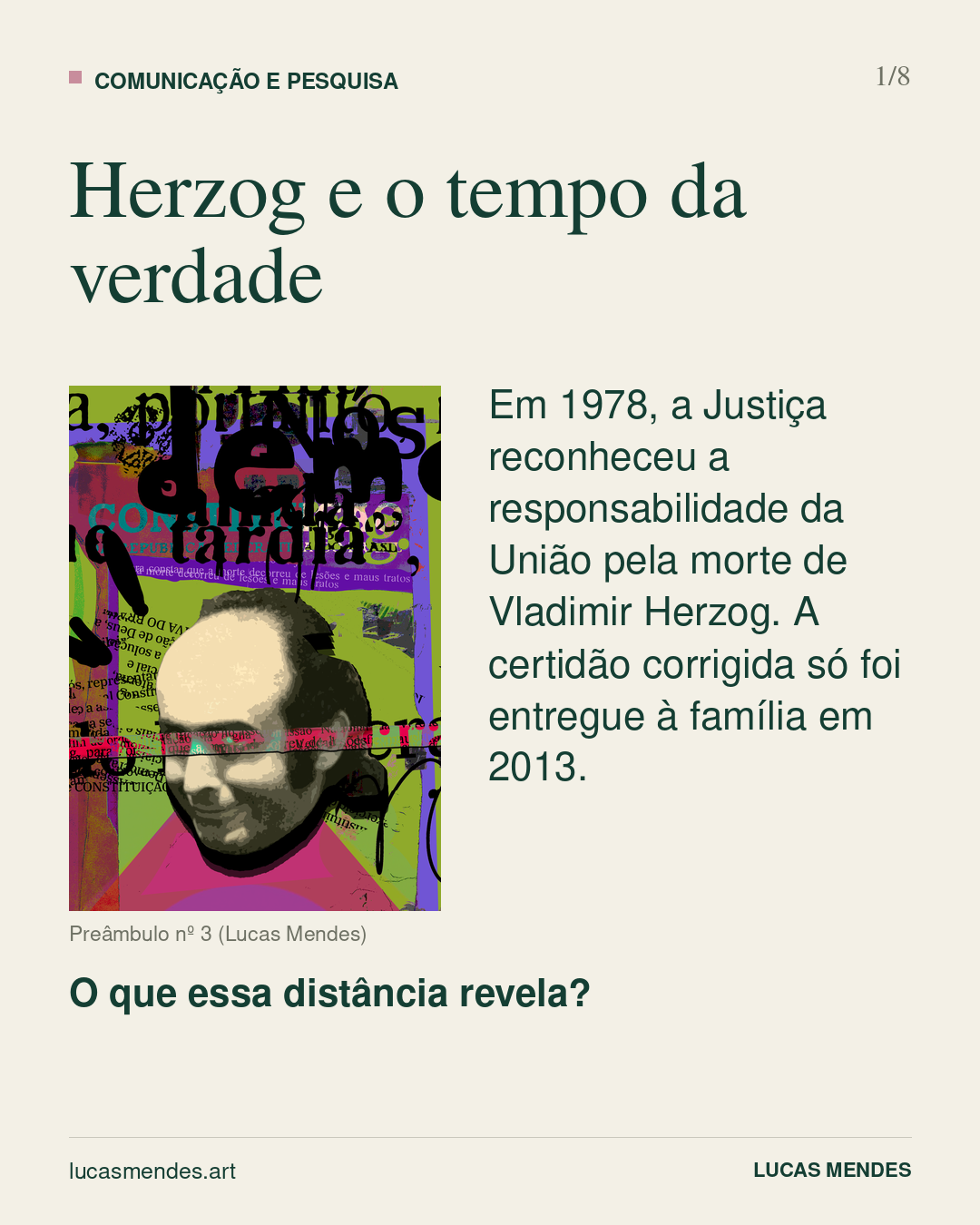
Between the 1978 judgment and the certificate delivered in 2013, Vladimir Herzog’s family had to seek a further measure to correct the record of his death. This sequence examines the scope of those responses and their relationship to Preâmbulo nº 3.
The original Portuguese carousel appears above; its complete English text follows below.
Read the article and consult the sources · Read the bulletin
The eight slides in English
1/8 — Herzog and the Time of Truth
In 1978, the courts recognized the federal government’s responsibility for Vladimir Herzog’s death. The corrected certificate was not delivered to the family until 2013.
What does that distance reveal?
2/8 — The falsehood entered the record
Herzog was tortured and murdered at São Paulo’s DOI-CODI on October 25, 1975. The dictatorship put forward an account of suicide. The cause recorded on the death certificate—“mechanical asphyxiation by hanging”—corroborated that narrative.
The false account acquired the authority of a document.
3/8 — Acknowledgment came in stages
On October 27, 1978, the federal court recognized the federal government’s responsibility. It was a civil judgment: it did not criminally convict the agents involved. Nor did it change the death record at that time.
The judgment changed one response by the state. The record remained the same.
4/8 — Correction required another dispute
In 2012, the National Truth Commission submitted the request for correction, supported by a request from Clarice Herzog. The court authorized the change. An appeal sought to exclude the reference to injuries and mistreatment; the correction was upheld.
The dispute over the wording affected the acknowledgment of violence.
5/8 — The document changed, but the case did not end
On March 15, 2013, the family received the corrected certificate, more than 37 years after the death. In 2018, the Inter-American Court held Brazil responsible for failing to investigate, bring to trial, and punish those responsible.
Correcting a record does not replace a criminal investigation.
6/8 — A new correction, a different scope
National Council of Justice Resolution 601/2024 created a free administrative procedure for the records of people who died or disappeared for political reasons and fall within its scope. The new delivery of certificates in October 2025 included Herzog. The standard explicitly identifies violent death caused by the state in the context of political persecution.
It deepened the correction; it was not the first correction.
7/8 — What does this delay contain?
Time also passed after the violence had already been acknowledged. The family had to seek further measures to give that acknowledgment practical effect. Each achievement had a scope; none, by itself, answered everything.
Acknowledging violence requires giving that acknowledgment practical effect.
8/8 — However belated
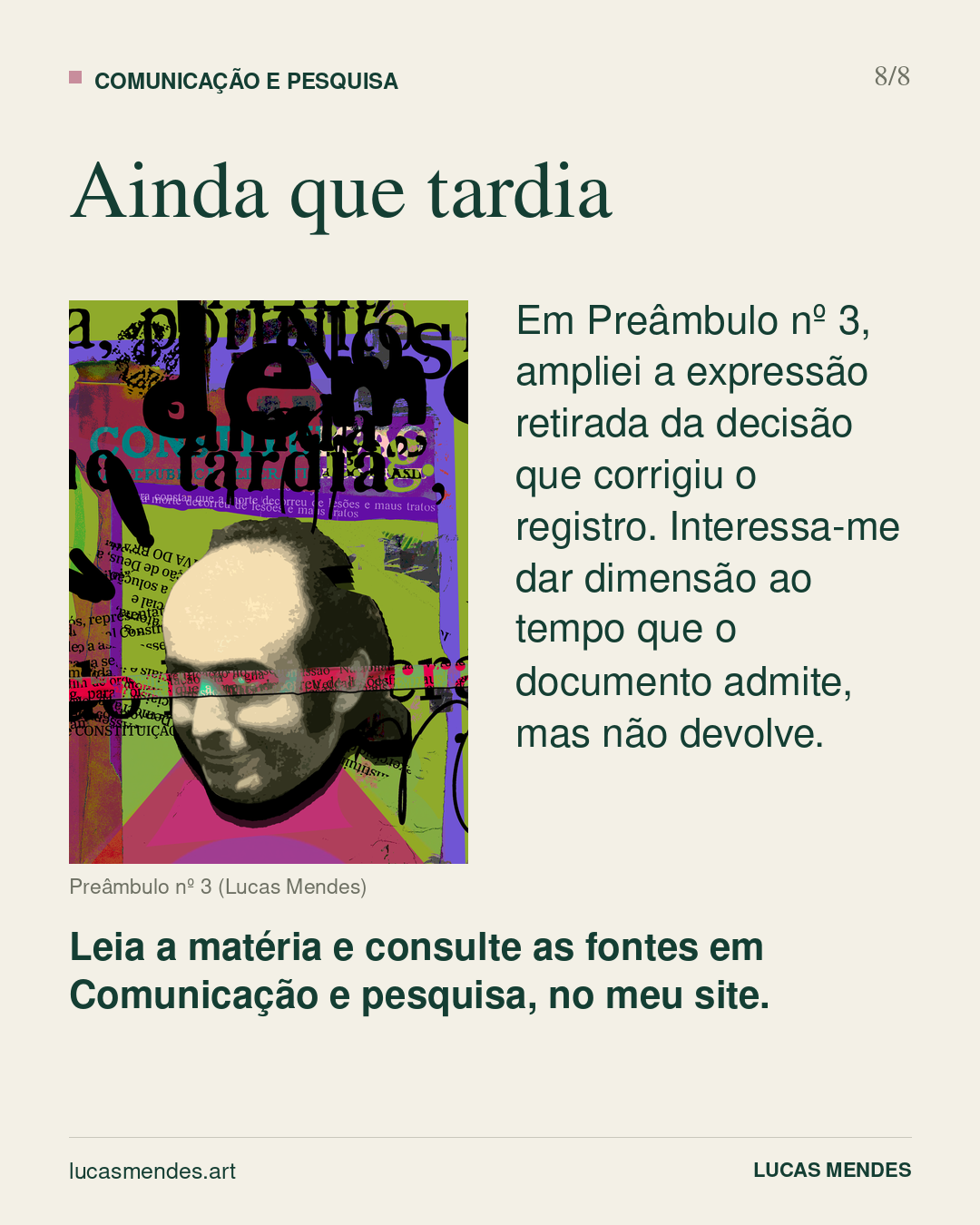
In Preâmbulo nº 3, I enlarged the phrase taken from the ruling that corrected the record. I am interested in giving a sense of scale to the time that the document acknowledges but cannot restore.
Read the article and consult the sources in Communication and research on my website.